
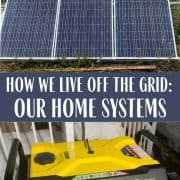
Living 30 minutes outside of Yellowknife, NWT, has its share of challenges. These challenges start with living outside of the power grid coverage. And since we get so many questions about how we live off the grid and our off grid home systems, I thought I'd write a quick overview of some of the systems in place to keep our home going.
To begin with, we live on a beautiful lake that has pristine water. And that's an obvious benefit when living off the grid. We pump water from the lake year-round with a well-insulated lake pump.

Our Water System
Our off grid water system setup is pretty unique. And our off grid water system winter setup includes using our glycol heat lines to keep water flowing to our holding tank setup.
We use the water from the lake for everything from bathing to washing dishes and even drinking. (We use a Berkey Water Filter System (affiliate link) as well for drinking water.)
The heart of the internal water system is our SHURflo 2088-313-145BX, which is a 12-volt DC diaphragm pump.
It gives us plenty of pressure throughout the house, whether operating a shower, tub, dishwasher, the toilets or our off grid washing machine. It pumps directly from our 1100-gallon holding tank and pressurizes the whole house.
From freshwater, we move to the discharge streams, which are both grey and black water.
Black Water
Black water is anything that goes through the toilet. And by that, I mean the everyday human waste, more commonly known as poop.
Our black water goes directly to a 2000-gallon holding tank that is conveniently located below us. It's approximately ¾ under the house and ¼ outside the house's footprint, yet still enclosed by an insulated structure.
The cover is easily accessible, as we just added a ladder to it this past year. It also has a pump-out pipe that extends horizontally about 15 feet. This makes it pretty convenient when the local sewage company comes to pump it out two or three times a year. That's based on how many visitors we get and how many bran flakes we consume.
Grey Water
Our grey water system is somewhat different. It goes directly to the outside.
Our greywater gets distributed out the back of our property, or the lakeside. Sitting some 60 feet above the lake allows the water to be naturally filtered through the ground, even though we sit on a lot of bedrock.
The showers and sinks all feed through one 2" PVC pipe, and the washer through a separate 2" PVC pipe. In warmer months, this runs to a barrel, and my wife uses it to water the garden in the very dry summers here.
We're challenged in the six months of winter, ensuring that there are no low spots in the pipe. We need to keep a fair slope mixed with daily wood stove-heated water to prevent the line from freezing.
I failed this week. And it froze, resulting in 10 hours of heating the pipe with a hairdryer, complaining, a little cussing and a lot of begging to get it thawed out and running smoothly again.
I ended up running the generator and a hairdryer continuously to finally thaw a particular section of pipe.
Speaking of the generator, that leads us to the electrical part of our off grid system. Our off grid home is wired like any other house for the most part.
Our Off Grid Electrical System

Since we live off the grid, we generate our own energy instead of receiving it from the grid. We do have a few sources of power generation, that being an 11.5 kW Kubota diesel generator, one regular gas-powered generator, and a Tesla 2 Powerwall with solar panels.
One of the biggest off grid living mistakes you can make is underestimating the costs of your alternative energy equipment. Some of the off grid expenses we didn't expect were generator repairs and parts.
The two diesel generators we have are 10kw Lombardinis that we have housed in a separate power shed located about 50 to 60 feet from the house. The shed is heavily insulated. That helps both winter temperatures as well as reducing noise. It is about 10' x 10' in size. Our generator shed also houses our extra 11kw Champion gas-powered generator. We keep that one as an additional backup to ensure we have power if there are any issues with the diesel.
UPDATE: On Christmas Eve, 2019, our 40-year-old generator shed burned to the ground. That was the end of our Lombardinis. We now (finally) have a new 11.5 kW Kubota diesel generator and Tesla 2 Powerwall/Solar panels setup.
Troubleshooting Home Generators
Learning how to troubleshoot generators is one of the most valuable things you can do if you're preparing to live off the grid. Even if you're just running a portable backup generator. This is especially true if you plan to move off the grid to a remote location.

Here are a few resources to get you started.
- Generators for Beginners
- Generator Won't Start? Try This
- 10 Things to Know About Buying a Generator for Home Use
- Solar Panels for Living Off The Grid: Beginners Guide
How We Live with Solar Panels in the Arctic
We get many questions about how we live off the grid through the winter months in Canada's subarctic. We depend heavily on our solar panels for power year-round.
However, we have limited daylight (about four hours per day) in winter. That's why we recently invested in additional solar panels. We need to access all the daylight we can to power our off grid home.
We have eight Kyocera 80 (KC80) watt solar panels on our roof with an additional 10 recently purchased 250-watt panels purchased that will be installed this coming spring. If we get one this year. These are each critical pieces of our power system, especially while we live off the grid in the far north, where we need power to avoid ending up with frozen children statues.

Update July 2020: We installed 9 250 Watt panels last summer and it made a HUGE difference. We'll be adding even more this summer.
Update March 2022, see above. Tesla 2 Powerwall and Solar Panels. We will write up a new review post in the near future.
March 22 update: As of April 2021, we have a brand-new system, as mentioned above! We're keeping this section here, though, because we get many, many questions about what we had. Keep in mind that our old system ran our house for 40 years. With various updates and upgrades, of course.
Our Off Grid Power Storage
Wondering how we capture, store, maintain, and distribute such self-generated power? We personally have a battery bank consisting of a dozen batteries that serve us well.
Our off grid battery bank system includes 12 Surrette 530 6 Volt Three (3) Cell deep cycle off grid batteries. These are specifically designed for solar panel photovoltaic, inverter, renewable energy, and alternative (alternative energy) applications.
We configured this battery bank for a 24-volt power source. The batteries themselves are easy to maintain. They do require occasional maintenance to ensure the water levels stay above the plates. We also periodically conduct battery equalization.
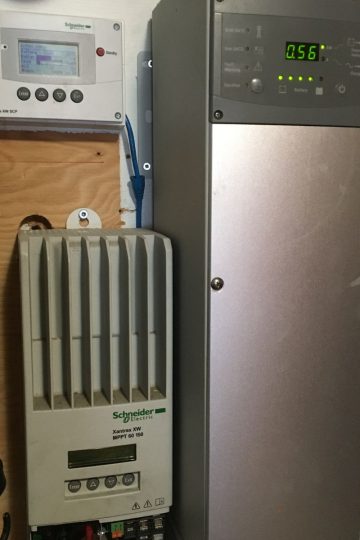
Our Schneider Inverter can be programmed to complete the equalization electronically.
We originally had the Xantrex DR Series 2412 inverter, giving us a 12-volt system. We decided to upgrade to a Schneider Conext SW4024, which allows us to operate at 24 volts. This is especially helpful when pumping water from the lake without using our generator.
Our two-story, chalet-style home is in Canada's Northwest Territories, at about 62 degrees North. To the west of us is the Yukon Territory, and beyond that is Alaska.
It gets very cold up here in the winter. For example, we usually have at least a few days in January or February when temperatures dip into the -48 °C range. That's -54.4 Fahrenheit.
So we actually have multiple heat sources, yet the heart of our system is our new propane boiler.
Our Propane Boiler
In 2019 we had to install a wall-mounted combi boiler when our 250,000 BTU Weil McLain EGp65 propane-powered boiler finally died. The boiler itself heats our closed-loop glycol system, which unfortunately requires electricity to operate the circulation pump. We managed with just our wood stove through a couple of -28 Celsius days in March and April while we saved money for a new boiler.
In June 2019, we finally had propane Vmax MTI combi boiler and on-demand water heater installed. We would not get another combi boiler. It's a huge headache.
In-Floor Heating with Glycol Lines
In-floor heating systems are nothing new. But ours is a bit different because of the extreme cold temperatures we can experience in the winter.
This past winter, for example, we had a couple of ten-day-long stretches where the temperature remained below -40 Celsius. So we need glycol in our lines.
The glycol (anti-freeze) gets heated and then flows through the manifold, a contraption that looks like an octopus. It directs the glycol through the in-floor PEX lines and the upper-level perimeter baseboard heaters.
This is a great heat source since it keeps the lower-level floor warm in the kitchen, laundry room, bathroom, and living area. It also keeps the upper-level wall chill at bay.
In addition to the boiler heat, we have a wonderful Osburn 2400 woodstove. Our particular woodstove is rated at 100,000 BTUs with the capability of heating a home up to 2700 square feet. Update: New wood stove installed in November 2019!
Both our boiler and woodstove generally operate together throughout the colder winter months to keep our family comfortable.
Heating with Firewood
The availability and cost factor of a good, clean wood source challenge those of us who heat with wood in the north.

The Firewood Situation
We have two avenues for firewood. They are Home Grown or Purchase. And yes, there are pros and cons to each.
Home Grown Wood
In our region, we can find spruce and birch trees. Yet none grow very tall or large in diameter as would be preferred for firewood.
And to harvest any trees locally, we need a permit from the City of Yellowknife.
The permit allows residents to cut trees for firewood in various "burn" sections scattered throughout the region. However, the closest burn sections are roughly a 2-hour drive from our house. And the fines for failing to get a permit before cutting can be quite hefty. Note, there is no charge for the permit.
Getting Firewood From Burn Sections
For those who don't know, a burn section is an area where forest fires have passed through but did not completely burn the forest down. Many trees, although charred, remain standing and available for harvest. The wood is not really bad, but it isn't the cleanest.
When getting our own wood, we have to factor in the cost of the trip to the burn section. The road conditions can have an extreme effect on both the truck and the trailer.
It is a *really* bumpy road. Our road is constantly being repaired and flexing due to the extreme climate that regularly impacts its operating condition. So the combination of gas prices, vehicle and equipment wear and tear, and potential axle repair or spring replacement makes a purchased-delivered load a viable financial option.
Purchased Wood
When buying wood, there are a couple of routes to follow.
We generally have folks in the area who advertise wood for sale. The costs can range from $400 to $500 per cord. Many also have a delivery fee of $30 to $50 per cord tacked on. When you burn 10 to 12 cords a year, as we do, you can see how the costs add up.
You also have to consider the cord size, whether it is chunked and split, and the delivery vehicle size. Then sometimes you'll find that the "cord" isn't a true cord, and you're shortchanged. These sellers that manage to get a permit will generally hit the same "burn" sections mentioned earlier.
The second option is to purchase a sawmill down in Hay River. It's a community about five to six hours away on the south shore of Great Slave Lake.
The sawmill in Hay River has a huge 18-wheeler "push" trailer that carries from 20 to 24 cords of firewood, based on how well it is piled. The wood is much better quality, larger diameter and it is already split and is not from a burn area.
As of 2019, the price for a delivered load is a flat $6,300 CAD or $275 to $310 a cord, based on how well it is packed. The order we received late fall was about 23 cords and we ended up splitting with a neighbour.
Update March 2022 - as with most things, the cost of firewood has increased. This past year, our bill for 20 cords of wood delivered from the sawmill down south was $7300.00. It lasted us two years.
We Run Our Wood Stove 24/7
Although many will be shocked at the price (and we realize it's costly), sometimes you have little choice. We enjoy burning wood and will run the stove pretty much 24/7 for 6 to 8 months straight. We let it go out about every 4 weeks to do a thorough cleaning, but other than that, full flames ahead.

Update March 2022 - the editor, (aka Sarita, Dan's wife) doesn't like our new wood stove. I miss my old Renfrew wood-burning cook stove that we had in Ontario. I'm scoping out Pioneer Princess wood cook stoves online.....shhhh.....
This gives you a rough overview of our household systems.
If you have any questions, please ask in the comments below or reach out to us on our Facebook page. And if you want to see what we're up to these days, check out our Instagram page.
LIKE THIS POST? DON'T FORGET TO PIN IT TO YOUR FAVOURITE PINTEREST BOARD SO YOU CAN COME BACK TO IT LATER!


Just wondering, you put in several updates for your systems. Links would be nice to get to what you are now doing.....Thanks for sharing all of your systems with your readers.
Hey Esme! Thanks for the comment. We have a Bell wireless internet hub and actually get a pretty good signal. I wrote about the options for internet off the grid right here - check it out https://www.anoffgridlife.com/internet-off-the-grid/
Hi, great information! I was wondering how do you get internet connection being off the grid?
Hi Lee - thanks for the comment! You know, every couple of years we do talk about getting a windmill. Several people in our area do have them, and they seem to work well - except for our one friend who almost had too much wind and power - he was afraid he'd fry his whole system. So definitely another potential alternative energy source we might look at down the road.
What do you think about wind energy? RV turbines are inexpensive and produce a good amount of energy. In winter I get almost 24hrs of energy production. Solar is 4-6 hrs... was cheaper than my solar set up. I'm surprised that I don't see as much about wind...
Thanks for the comment, Candy! Solar panel options for residential use have really come a long way in the last five years or so. 🙂
We are on well water and we heat with wood. Would like to put in solar panels soon. Found you on Simple Homestead Blog Hop.